

Keyword research is the backbone of any successful digital lead generation strategy. Through identifying search terms people use, you can optimize your content to attract the right audience and improve your lead generation efforts.
Definition of Keyword Research
Keyword research is the process of identifying and analyzing the search terms that people enter into search engines. This helps SEO consultants and marketers understand what their audience is looking for and how to optimize your content to meet those search queries.
Importance of Keyword Research in Lead Generation
Effective keyword research is crucial for attracting targeted traffic, and enhancing lead generation strategies.
Through understanding what potential customers are searching for, businesses can create content that meets their needs that drives conversions.
Short tail keywords, also known as seed keywords, are broad and general terms with high search volume. They form the foundation of your keyword strategy and help create a broad focus for your content.
Long-tail keywords are more specific phrases with lower search volume but higher conversion rates. They drive targeted traffic due to their precise nature. Going for lower competition keywords can help in the initial stages of lead generation.
Understanding search intent is key to selecting the right keywords.
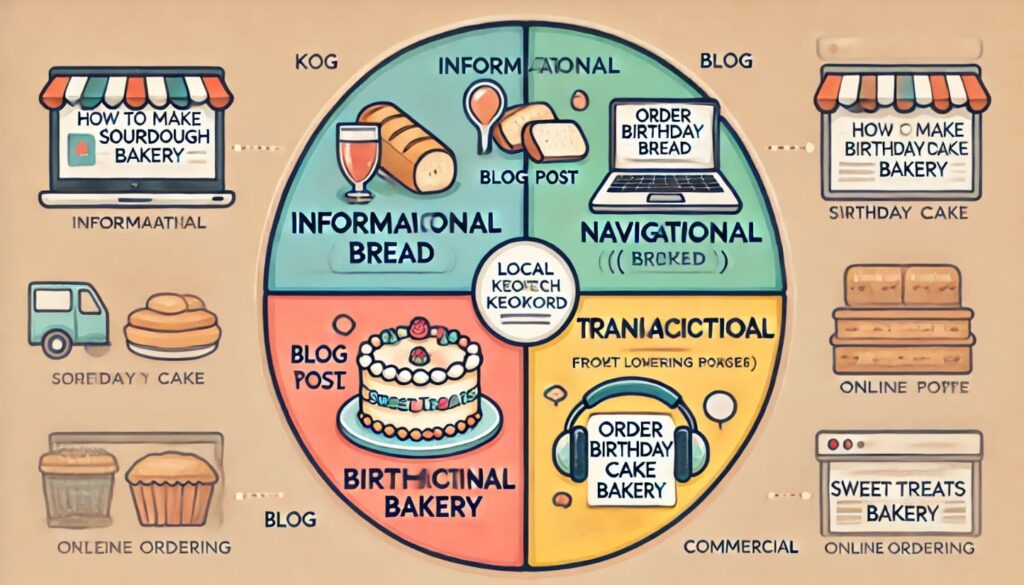
Informational: Users Looking for Information
Examples:
Keyword: "How to make sourdough bread"
Content: A blog post or video tutorial from the bakery explaining the step-by-step process of making sourdough bread at home, including tips and tricks.
Keyword: "Benefits of whole grain bread"
Content: An article detailing the health benefits of whole grain bread, showcasing the bakery's whole grain bread options.
Navigational: Users Trying to Find a Specific Website
Examples:
Keyword: "Sweet Treats Bakery website"
Content: The homepage of Sweet Treats Bakery, making it easy for users to find the website directly.
Keyword: "Sweet Treats Bakery menu"
Content: A direct link to the menu page on the bakery's website, where users can view all the bakery's offerings.
By targeting these different types of search intent, the bakery can create content that meets the specific needs of potential customers:
Selecting keywords that match user intent enhances relevance and effectiveness.

Several tools can help you conduct effective keyword research:
Analyzing competitors’ keywords helps identify gaps and opportunities. Tools like Ahrefs and Semrush can provide insights into your competitors' strategies, showing which keywords they rank for and how you can compete.

Start by generating a list of basic terms related to your business. Involve customer-facing employees to learn about common queries and concerns. Use keyword research tools to expand this list and analyze metrics like search volume, competition, and CPC.
Focus on low-competition, high-intent keywords that align with your business goals and target audience.
This approach ensures that your efforts are directed towards keywords that can drive significant leads.
Score your keywords based on their potential to drive leads and align with business objectives. This helps prioritize efforts and allocate resources effectively.
Examine search results to understand the type of content that ranks for your keywords. Adjust your strategy based on these insights to better meet user intent and improve relevance.
Ensure that there are no overlapping keywords in your research. For example, if you Google “swimming classes in Singapore” and “swimming classes” from Google.Com.Sg, you are going to get similar search results.
Henceforth there may be keyword cannibalization involved. Ensure that existing pages are targeting the same keywords that have the same search intent.
Conduct content audits and consolidate pages if necessary to prevent keyword cannibalization, which can dilute your SEO efforts.
Is important to track performance for your strategy. Our lead generation services include using analytical tools to monitor the performance of traffic and keywords.
Key metrics to track are ranking positions, organic traffic, and conversion rates. You have to review regularly and adjust your strategy based on these insights to improve your lead generation campaigns.
Keyword research is essential for attracting targeted traffic, and improving lead generation. Through understanding and implementing effective keyword research strategies, you can optimize your SEO approach to better meet the needs of your audience and drive more leads for your business.
*This post contains affiliate links that we can earn a commission for.
