


It’s strange how something small can break your entire link-building campaign. All you "need" is just one wrong word, or one over-optimized phrase. And out of nowhere, your backlinks look manipulative, your internal links confuse users, and don't get us started on what's going on with your rankings.
All that can be caused by an anchor text in SEO. Yes, that tiny, clickable piece of text that tells users and search engines what a page is about. It looks harmless, but in reality, it's not.If you get it wrong, your link profile will look spammy (even if it's not). But if you get it right, it improves UX and supports your rankings. So, to avoid any costly mistakes, let's figure everything out.
What is anchor text in SEO?
An anchor text is the clickable words in a hyperlink. Instead of showing the full URL like this: https://example.com/seo-guide, you insert the link inside the phrase. For example: “read our complete SEO guide”.
Take a look at the highlighted text below:
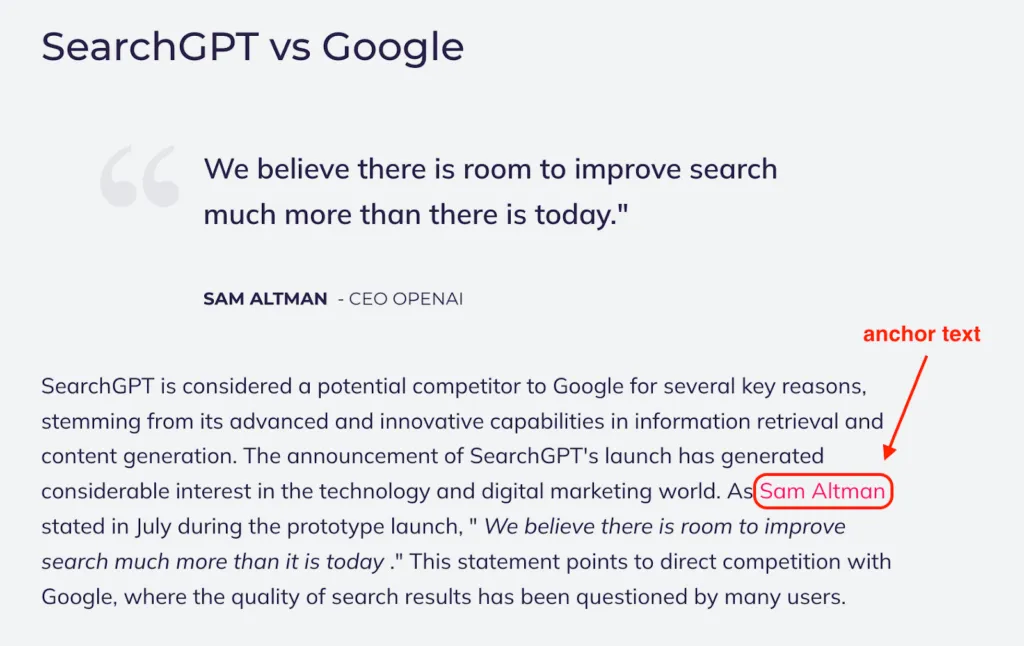
That's the anchor text that leads to Sam Altman’s blog. That highlighted phrase, basically, does two things:
- Tells users what they’ll find when they click the link,
- And shows Google what the page is about.
Why is it important?
When search engines “review” backlink profiles of any website, they always pay attention to anchor texts. So, even though they seem like a detail that’s too small to matter, they matter because anchors help:
- Search engines understand the content and how external websites perceive it.
- Users navigate more easily across your website ( UX is huge for both SEO and GEO).
- You build topical authority because when more people link to you using relevant keywords related to a particular niche, Google notices that.
- Your website’s structure becomes clearer thanks to the descriptive anchor texts you use for internal links.
That’s why these small phrases play such an important role in your SEO. So, if you’re betting on link building to monetize your website, help it grow and become more visible, you have to learn to use anchor texts strategically.
Types of anchor text
The main goal is to have a diverse backlink profile with different anchors. So, let’s take a look at some of the main options you can (and should) use.
Branded
This one means using the company name as the anchor. It could be DesignPlus, Semrush, Apple, Nike, or any other brand. In real life, it could look like this: “One of the most popular digital marketing agencies in Bogota is DesignPlus.”
This is one of the safest types of anchor texts in SEO because it looks very natural to search engines.
Exact keyword match
An exact keyword match is exactly what it sounds like: using your main search queries as the anchor text.
- If you’re a CRM company, your target query could be "best CRM software."
- If you’re a flower delivery service in Atlanta, your search term and anchor could be “same-day flower delivery in Atlanta.”
- If you’re a digital marketing agency in Bogota, the keyword-based anchor could be “digital marketing agency in Bogota.”
These anchor texts are great because they give search engines the context of what your business is all about. Yet, there is a risk. If you overuse it, the Google algorithm might think it's manipulative. It only applies to backlinks, though, not your internal links.
Remember the 2012 Google Penguin update? It was designed to fight backlink manipulations. This update’s “job” was to penalize websites that were influencing rankings through unnatural link-building practices.Before that, people ranked pages by buying hundreds of spammy backlinks or stuffing exact-match SEO anchor text everywhere. But this update stopped that. And now, these approaches are an absolute no-go.
Partial keyword match
Partial keyword anchors basically include a variation of your main keyword and some generic text. If you target a query "email marketing tools", then the partial match anchor could be:
- “Top email marketing strategies,”
- “Compare leading email automation tools.”
- “Affordable tools for newsletters,” etc.
This is a far safer type of an anchor, and it is way more natural. But still, don’t overdo it here, either, because it shouldn’t be the main type you use.
Naked URL
A naked URL is just the link itself used as an anchor. For example, it could be “https://designplus.co/blog/.” While this isn’t the most popular link type you’ll see in blog posts, it’s quite common in:
- Forums,
- Citations,
- Source references,
- And platforms like Reddit, Quora, etc.
They don’t send strong topical signals, as exact or partial keyword anchors do. But that’s actually a good thing.
In a healthy backlink profile, you want some naked URLs, too. Real people often paste links exactly like this. So, if your backlink profile has no naked URLs and only keyword-rich anchors, that looks way too engineered.Long story short: while naked URLs are not that powerful from a ranking standpoint, they’re extremely valuable for maintaining natural balance in your anchor text strategy.
Generic text
Generic anchor texts use non-descriptive phrases that don’t include any keywords. You've seen these millions of times:
- Click here,
- Read more,
- Discover details here,
- This page,
- Visit this site, etc.
These can also be more creative, like “consider different options,” tired of waiting,” etc. Essentially, it’s any text that has nothing to do with your brand, niche, product, or service.
While this type of anchor doesn’t tell search engines anything about the destination page, at least around 20% of your anchor text profile should consist of these. Mainly because they look realistic and don’t attract any unnecessary attention from Google.
Best practices for using SEO anchor text
Whether you’re using guest blogging or niche edits for your link building, it’s easy to hurt your strategy with the wrong link’s anchor text. But it’s also easy to avoid that if you’re following these simple best practices.
Use relevant anchors
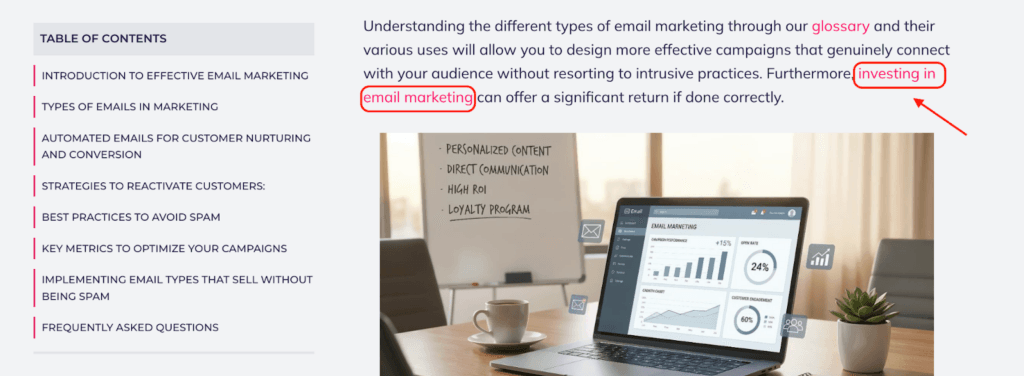
Your anchor text must clearly match the topic of the content you're linking to. And it has to be contextual, meaning related to the topic of the page where you place that link.For example, here is a blog post about different types of email marketing, and it links to another relevant article on the importance of investing in email marketing with a descriptive anchor:
Why does this matter?
Google uses anchors to understand what the destination page is about. If your link’s anchor text is the same as the content, your topical clarity is there. If it’s misleading, you blur signals and most likely increase your bounce rates.
Keep the text concise and natural
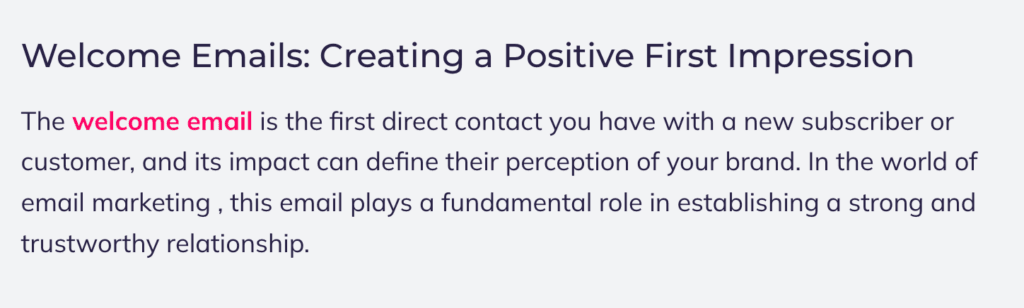
Anchor text should flow inside a sentence. If it feels forced, it probably is forced. For example, if you say, "Read our comprehensive, ultimate, advanced, professional-level SEO optimization tutorial guide," it looks ridiculous. Of course, we’re exaggerating, but you get the idea.What you need is a short, clear, descriptive, and natural phrase that fits in perfectly. Below, you can see a very good example. The anchor is “welcome email,” and it leads to a blog post on how to create good welcome emails. See? Easy and straightforward.
Here is a rule of thumb you can keep in mind:
- 2-5 words are enough,
- Avoid stuffing multiple keywords,
- Don’t over-explain inside the anchor (let the surrounding sentence provide context).
Stick to the “golden ratio”
This is where most link-building campaigns go wrong. After the Google Penguin update, websites with heavy exact-match anchor distribution lost rankings very quickly. Why? Because normal pages don’t naturally get 60% of their backlinks using the same commercial keyword anchor.
What does a healthy anchor profile look like?
It’s really important to understand that Google never mentioned any perfect ratio for anchor text for backlinks. But over the year, after endless trial and error, different SEO experts shared their experience, and here is a ratio you can stick to:
- 40-50% branded anchors
- 30-35% generic
- 10-15% naked URLs
- 5-10% partial match
- Under 5% exact keyword
Whatever you do, avoid having more than 10%-15% of keyword-based anchors. Again, this applies to backlinks only. Your internal links should be topically relevant and explain exactly what your content is about. But when it comes to getting external links, whether you’re buying backlinks or trying to gain them naturally, make sure you have a clear link-building report that tracks the ratio of your anchor texts.
Avoid using too many links next to each other
This one is another small detail, but it affects both UX and crawl signals. Bad practice, in this case, would be: "Learn about SEO, keyword research, technical audits, link building, content marketing, and analytics."
That’s six links in one sentence. And that's an awful example of too much of everything in one place. If those are internal links, it’s not that bad. But if those are external ones, it definitely looks too spammy.
Conclusion
If you zoom out, you’ll see that anchor text in SEO helps your credibility signals. Your job is not to outsmart the algorithm, or to fool it. Your job is to keep your backlink profile natural. And one of the best places to start is by fixing your anchor texts.
